
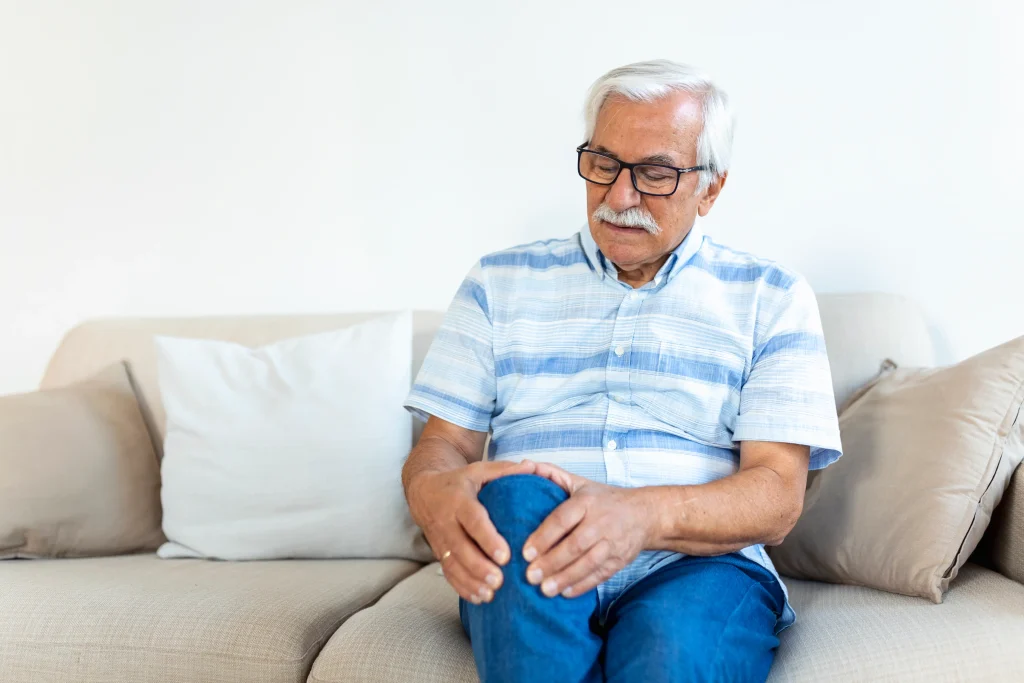
Why Knee Pain Is So Common in the Elderly
The knee carries the whole body, thousands of steps a day, for decades. Knee pain is one of the most common complaints in old age.
Also, muscles weaken with age. Weak thigh muscles mean the knee absorbs more shock. As a result, pain increases and walking becomes harder. Then a dangerous cycle begins — pain leads to less walking, less walking leads to more weakness.
Is It Arthritis? Signs of Knee Osteoarthritis
Osteoarthritis is the most common cause of elderly knee pain. It develops when joint cartilage gradually thins over the years.
The typical pattern looks like this. Pain builds slowly over months or years. Stiffness appears in the morning but eases within thirty minutes. Pain worsens with activity — especially stairs — and settles with rest. Furthermore, the knee may grind, click, or look slightly swollen.
Here is an important scientific fact. X-ray damage does not equal pain. Studies show many elders with arthritis on X-ray feel no pain at all. Meanwhile, others with mild X-rays have severe pain. In fact, muscle strength often predicts pain better than the scan does. This is genuinely good news — because strength can be rebuilt at any age.
Or Is It Something Else? Other Causes of Knee Pain
Several other problems mimic arthritis in the elderly:
- Meniscus wear. The knee’s cartilage cushion frays with age. This causes catching, locking, or sharp pain on twisting.
- Bursitis. Inflamed fluid sacs around the knee cause localised tenderness, often at the front or inner side.
- Baker’s cyst. A fluid swelling behind the knee that causes tightness and aching.
- Referred pain from the hip or back. This one surprises families. A worn hip or a pinched spinal nerve often sends pain to the knee. Consequently, some “knee patients” actually have a hip problem.
- Gout or pseudogout. Crystals in the joint cause sudden, severe attacks. The knee becomes hot, red, and swollen within hours.
A physiotherapy assessment separates these causes. We test the knee, the hip, and the spine — because the true source is not always where the pain is.
When to See a Doctor First
Most knee pain is safe to treat with physiotherapy. However, some signs need a doctor promptly. See a doctor first if the knee is hot, red, and suddenly swollen. Also seek help for fever, inability to put weight on the leg, or constant night pain. These signs may indicate infection, gout, or a fracture. Then, once cleared, physiotherapy can begin safely.
Home Physiotherapy and Knee Pain: What Science Says
The evidence here is remarkably strong. International guidelines for knee osteoarthritis — including NICE in the UK — recommend exercise as the first-line treatment. Not as an add-on. As the core treatment, ahead of long-term painkillers.
Research shows strengthening the thigh muscles reduces knee pain and improves walking. In several studies, the effect matches common pain medications — without the side effects.
Furthermore, exercise does not wear the joint out. Many elders fear movement will cause more damage. The science says the opposite. Joints need movement to stay nourished and healthy. Yet the exercise must be correctly dosed — which is exactly what a physiotherapist provides.
There is one more reason to act. A painful knee changes walking, and unsteady walking leads to falls. The World Health Organization lists falls as a leading cause of injury in older adults — see the WHO falls fact sheet.
Home Physiotherapy for Knee Pain: How We Treat It in Dubai
Our DHA licensed physiotherapists assess the knee at home. First, we find the real cause — knee, hip, or spine. Then we build a plan around your parent’s actual daily life.
Treatment includes strengthening, hands-on pain relief techniques, and safe movement retraining. We practise on your parent’s own stairs and chairs. Our services cover arthritis pain management, functional mobility, and stair safety across Dubai and Sharjah.
Is your parent’s knee pain limiting their life? Do not assume it is “just old age.” Contact 800Physio today and book a home assessment this week.